CURE RESEARCH :
In addition to our efforts to complete the experiments required for an IND application to the U.S. Food & Drug Administration, our scientists are interested in expanding our basic science research on prostratin. This research was recently advanced by gifts from the Pepsi Refresh Project, the Entertainment AIDS Alliance, and the Robert Sabo Trust.
For example, a project recently funded by the Sabo Trust examines the effects of combining prostratin with genetically engineered cytotoxic T lymphocytes to increase HIV-induced cell death. This work is being accomplished in collaboration with researchers at UCLA.
Specifically, CD4+ and CD8+ T cells will be isolated from HIV+ individuals. prostratin will be used to treat CD4+ T cells, while the CD8+ T cells will be genetically engineered to target cells infected with HIV. The goal of this research is to identify any synergistic immune responses by activating the viral reservoir and priming immune cells to target HIV.
Other research underway examines the potency and effects of prostratin analogs, and the effects of additional compounds—including HDAC inhibitors, valproic acid, immunotoxins, and IL-7—in targeting the viral reservoir. Our basic science program will not only expand our knowledge of prostratin, but may also provide insights on how the viral reservoir is created and maintained.
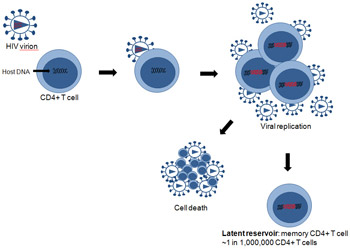
HIV is able to remain a chronic, life-long infection due to its ability to stay hidden within infected blood cells. These cellular “reservoirs” contain the genetic code of HIV. They remain invisible to our body’s immune defenses, and are not sensitive to anti-HIV drugs.
Latent reservoirs of HIV are located throughout the body, including the brain, lymphoid tissue, bone marrow, and the genital tract. These reservoirs persist, even in the presence of Highly Active Antiretroviral Therapy (HAART), today’s standard of care. While HAART is able to deplete the reservoir, it does so very slowly. Mathematical models have shown that most patients would have to be on HAART for 60-80 years before their HIV reservoirs are depleted.
\
One proposed eradication strategy is to activate these latently infected cells in the continued presence of HAART. The rationale for the strategy is two-fold. By stimulating latently infected cells to replicate and express the virus, such cells will die more rapidly [HIV-induced cell death]. Once the cellular reservoirs begin producing HIV, the infected cells will be recognized by the immune system. The key to this strategy is the simultaneous administration of an activating agent concurrently with HAART, and perhaps other therapies to prevent new or spreading infection.
(Figure 1. The HIV latent reservoir. Infection of CD4+ T cells by HIV will result in cell death or apoptosis in most cells. However, some cells will return to a quiescent state, transitioning into a memory CD4+ T cell. These cells contain an integrated copy of the viral genome (red) within their DNA (black) and are transcriptionally silent with no viral gene expression.)
AIDS Research Alliance is developing the drug, Prostratin, which research suggests activates latently infected cells to produce virus. Our goal is to target these cells using a combination approach that will purge virus from the latent reservoirs.
(Figure 2. Targeting the viral reservoir. Treatment with prostratin will result in activation of latent viruses, inducing viral gene expression. A combination approach will include HAART and additional compounds that may result in enhanced immune responses, inhibiting new infections and increasing HIV-induced cell death.)
HIV MAY RAISE RISK OF HEART ATTACK :-
MONDAY, March 4 (HealthDay News) --
People living with HIV may face a greater chance of suffering a heart attack, a new study indicates.Researchers
looked at data on more than 82,000 U.S. veterans, and found that there
were 871 heart attacks in this group over a median follow-up of 5.9
years. The investigators also found that HIV-positive people had a
"consistently and significantly higher" risk of heart attack across
three decades of their lives.Among the veterans, heart attack
events per 1,000 people per year were: at ages 40 to 49, 2.0 for those
with HIV and 1.5 for those who did not have HIV; at ages 50 to 59, 3.9
for those with HIV versus 2.2 for those without HIV; at ages 60 to 69,
5.0 for those with HIV versus 3.3 for those without HIV.After
accounting for other risk factors, the researchers calculated that
people with HIV have an overall 48 percent increased risk of heart
attack.The study was published online March 4 in the journal JAMA Internal Medicine.
The
findings may not be applicable to women because the patients included
in the study were overwhelmingly male, study author Dr. Matthew
Freiberg, from the University of Pittsburgh School of Medicine, and
colleagues noted in a journal news release.The success of antiretroviral therapy means that HIV-infected people are living longer, and are now at greater risk for heart disease, the authors added.While
the study found an association between HIV and increased risk of heart
attack in the veterans, it did not prove a cause-and-effect
relationship.However, the findings show "a clear and consistent
excess risk" of heart attack in HIV-positive people across a range of
age groups, Patrick Mallon, from the University College Dublin in
Ireland, wrote in an accompanying commentary. He added that further
research is needed to learn more about the causes of this increased risk
and how to reduce it.
Researchers Describe 1st 'Functional Cure' of HIV in Baby
SUNDAY, March 3 (HealthDay News) --

A baby born two-and-a-half years ago in Mississippi with HIV is the first case of a so-called "functional cure" of the infection, researchers announced Sunday.Standard tests can no longer detect any traces of the AIDS-causing virus even though the child has discontinued HIV medication."We
believe this is the first well-documented case of a [functional] cure,"
said study lead author Dr. Deborah Persaud, associate professor of
pediatrics in the division of infectious diseases at Johns Hopkins
Children's Center in Baltimore. The finding was presented Sunday at the
Conference on Retroviruses and Opportunistic Infections, in Atlanta.The
child was not part of a study but, instead, the beneficiary of an
unexpected and partly unplanned sequence of events that -- once
confirmed and replicated in a formal study -- might help more children
who are born with HIV or who at risk of contracting HIV from their
mother eradicate the virus from their body.Normally, mothers
infected with HIV take antiretroviral drugs that can almost eliminate
the odds of the virus being transferred to the baby.If a mother
doesn't know her HIV status or hasn't been treated for other reasons,
the baby is given "prophylactic" drugs at birth while awaiting the
results of tests to determine his or her HIV status. This can take four
to six weeks to complete. If the tests are positive, the baby starts HIV
drug treatment.The mother of the baby born in Mississippi didn't know she was HIV-positive until the time of delivery.But
in this case, both the initial and confirmatory tests on the baby were
able to be completed within one day, allowing the baby to be started on
HIV drug treatment within the first 30 hours of life."Most of our kids don't get picked up that early," Persaud explained.As
expected, the baby's "viral load" -- detectable levels of HIV --
decreased progressively until it was no longer detectable at 29 days of
age.Theoretically, this child (doctors aren't disclosing the
gender) would have taken the medications for the rest of his or her
life, said the researchers, who included doctors from the University of
Massachusetts Medical School and the University of Mississippi Medical
Center.Instead, the child stayed on the regimen for only 18
months before dropping out of the medical system and discontinuing the
drugs.Ten months after stopping treatment, however, the child
was again seen by doctors who were surprised to find no HIV virus or HIV
antibodies with standard tests.Ultrasensitive tests did detect
infinitesimal traces of viral DNA and RNA in the blood. But the virus
was not replicating -- a highly unusual occurrence given that drugs were
no longer being administered, the researchers said.No one is
absolutely sure why this child achieved a "functional" cure -- meaning
the virus is in remission even without medications. But investigators
believe that giving antiviral treatment so early in life meant the virus
had no time to create viral "reservoirs" where dormant HIV cells can
linger for years before becoming active again."For us this is a
very exciting finding," said Persaud. "By treating a baby very early
[we may be able to] prevent viral reservoirs or cells that stay around
for a lifetime of an infected person."But Dr. Michael Horberg,
chair of the HIV Medicine Association and director of HIV/AIDS at Kaiser
Permanente, stressed that this was a "functional cure and not a cure in
the most classic sense of the word.""If we take adults off HIV
medications, they almost certainly within a short time period would have
levels of virus back to where they were before they were taking
medication," he said.Only one instance of a "sterilizing cure"
-- when there are absolutely no traces of HIV in the body -- has been
documented. This occurred in the so-called "Berlin patient," who
received a bone marrow transplant for leukemia.
The transplanted cells came from a donor who had a rare genetic
mutation that increases immunity against the most common form of HIV.
The Berlin patient has remained HIV-free after discontinuing drug
therapy.And Persaud said she is not advocating that the
Mississippi case become the standard of care. "This is a single case and
we don't really know what are all of the factors [involved]," she said.But the case does "pave the way now for us to immediately start
clinical studies to see if we can replicate these findings in more
infants," Persaud said. Those trials are ready to move forward.At the last follow-up, the child born in Mississippi was "doing well and was healthy," she added.Horberg
said the findings in the baby were "encouraging" but "time will tell"
if such a strategy can keep the virus under control for long periods of
time without medication.He emphasized that there are ways to prevent a baby from becoming infected in the first place."This
again shows the importance of testing pregnant mothers and getting them
into care and on [drug] treatment such that we wouldn't even need to
worry about it at this point," he said. "What's encouraging, though, if
it does come to this point, we might have some good treatment options."he
research presented Sunday was funded by the U.S. National Institutes of
Health and the American Foundation for AIDS Research
Certain Skin Cancers More Common in HIV-Positive People

Non-melanoma skin cancers are more common among people who are HIV-positive, according to new research.The study found that basal cell and squamous cell carcinomas, two of the most common forms of cancer in the United States, occur more than twice as often among those with HIV (the virus that causes AIDS).The
greater risk for cancer among people with HIV is likely due to immune
system deficiency, the researchers said, and those with the virus should
take extra precautions to protect and monitor their skin."The
clinical implications for these findings include increased vigilance in
skin-cancer screening for HIV-positive individuals, especially for
squamous cell carcinomas and particularly for those who are not on
antiretroviral therapy or who were diagnosed late and have more advanced
HIV/AIDS," senior study author Dr. Maryam Asgari, a dermatologist and
investigator at Kaiser Permanente's division of research, said in a
Kaiser news release."HIV-positive individuals should also be advised to reduce behaviors that may further increase non-melanoma skin cancer incidence, such as excessive sun exposure," Asgari added.The
study, using data from 1996 to 2008, involved more than 6,500
HIV-positive patients and nearly 37,000 other patients who tested
HIV-negative.HIV-positive patients were more than twice as likely
to develop basal cell carcinomas, the study revealed. They also were
nearly three times more likely to be diagnosed with squamous cell
carcinomas.Patients with squamous cell carcinomas often had lower
CD4 counts, which is a measure of immunodeficiency. The researches
noted that previous treatment with antiviral therapy was not linked to
either form of skin cancer.Lead study author Michael Silverberg,
also of Kaiser's division of research, said, "These findings represent
unique data on non-melanoma skin cancers in HIV patients. Most cancer
registries, on which previous studies relied, do not record these types
of cancers.""Given the increasing longevity for HIV-positive
individuals, the burden of many age-related, non-AIDS-defining cancers,
including [non-melanoma skin cancers], will only continue to increase,"
Silverberg said. "Based on our studies, non-melanoma skin cancers are by
far the most common cancer this population experiences."The findings have implications for changes in treatment, Asgari said."Given
the observed association of immunodeficiency and squamous cell
carcinomas, earlier initiation of antiretroviral therapy to maintain
higher CD4 counts may also help reduce the burden of this cancer," she
said.More than 3.5 million new cases of non-melanoma skin cancers
are diagnosed in the United States each year. Although most of these
cases can be easily cured, many become locally invasive and destructive,
according to the release.
The study, funded by research grants
from Pfizer, Kaiser Permanente Northern California Community Benefit and
the U.S. National Institutes of Health, was recently published online
in the Journal of the National Cancer Institute.
A breakthrough in AIDS research
A pair of
naturally occurring antibodies are able to kill more than 90% of all
strains of HIV, researchers say. The finding could lead to the
development of new treatments and a possible vaccine.
July 09, 2010|By Thomas H. Maugh II, Los Angeles Times
An effective vaccine against the AIDS virus may have moved one step closer to reality, researchers said Thursday.Federal researchers have identified a pair of naturally occurring
antibodies that are able to kill more than 90% of all strains of the
AIDS virus, a finding they say could lead to the development of new
treatments for HIV infections and to the production of the first
successful vaccine against the virus.HIV, the virus that causes AIDS, is notoriously mutable, changing the
composition of proteins on its surface with ease to escape pressure from
the immune system. This enables it to continue 
infecting cells even
after the appearance of antibodies targeting it — and to avoid the
relatively ineffective vaccines developed so far.Hundreds of
variants of the virus are now in circulation around the world, and the
identification of so-called broadly neutralizing antibodies that can
block the bulk of them has been the holy grail of HIV researchers.To date, however, the best antibodies — immune system proteins that
fight infections — that researchers have found block only 30% to 40% of
all HIV strains. The identification of antibodies that can block more
than 90% of strains could lead to what some researchers are dubbing a
renaissance in AIDS prevention and treatment.The key to the new antibodies is that they bind to a site on the virus surface that rarely mutates."I am more optimistic about an AIDS vaccine at this point in time than I
have been probably in the last 10 years," Dr. Gary Nabel of the
National Institute of Allergy and Infectious Diseases told Reuters. He
led the research reported Thursday in the online edition of the journal
Science.Nabel and his colleagues isolated the antibodies from
the blood of a 60-year-old African American gay man. Using newly
developed imaging and analytical techniques, they found that the two
antibodies, called VRC01 and VRC02, bind to a spike on the surface of
the virus. This spike interacts with a receptor called the CD4 binding
site on the surface of human cells, and when an antibody binds to it,
the virus cannot enter a cell.Because the virus must use CD4 to
enter cells, it cannot tolerate mutations in the spike. The composition
of the spike is thus pretty much constant in all variants of HIV in
circulation."The antibodies attach to a virtually unchanging
part of the virus, and this explains why they can neutralize such an
extraordinary range of HIV strains," Dr. John R. Mascola of the
infectious diseases institute, a coauthor, said in a statement.the antibodies in hand, the team was able to determine precisely
how the HIV spike and the antibodies interact. They were then able to
produce a synthetic version of the spike that could elicit the
production of similar blocking antibodies in animal cells.They
are now testing the synthetic spike as a possible vaccine in animals and
hope to expand to human testing in the relatively near future. The
antibodies can also be reproduced by biotechnology and used as a
treatment for someone who is already infected.Researchers, who
are already testing the antibodies in infected animals, hope that at the
very least the antibodies will provide synergistic effects when used in
conjunction with antiviral drugs.
French research gives scientists hope of 'functional cure' for HIV:
Small group of patients were able to stop taking Aids drugs without any resurgence of the virus in their bodies, study find
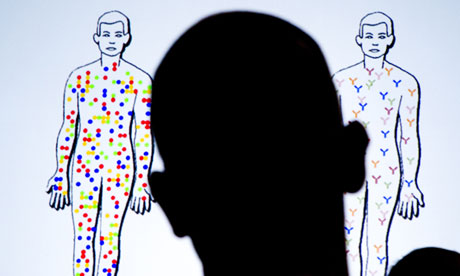
The study is one of
several that have boosted hopes not of a total cure for HIV, but of what
is being called a functional cure. Photograph: Carolyn Kaster/AP
A small group of patients with HIV in France have been able to
stop taking Aids drugs without any resurgence of the virus in their
bodies, giving scientists new hope that a "functional cure" for HIV may
be possible.The Visconti cohort, as the 14 French patients are
being called, were all given antiretroviral drugs to control the virus
soon after becoming infected with HIV, which is not very common. They
remained on medication for at least three years, but then stopped.Usually,
the levels of virus in the body will rise without drug suppression and
cause the patient to become ill and eventually develop Aids. But the
Visconti cohort has remained well, with extremely low levels of virus in
their system, for a median of seven years."We believe that this
is a really promising group of patients," said Asier Saez Ciron from the
Institut Pasteur in France, one of the scientists involved in the
research which was presented at the International Aids Conference in
Washington.The existence of people who do not become ill even
though they are infected with HIV – the so-called "HIV controllers" – is
already known. The excitement felt by scientists over the Visconti
cohort is because it appears that medical intervention has brought about
similar results."This is a promise that the functional cure could be achieved," said Saez Ciron.The work is further evidence that people should be given drugs as soon as possible."These
results suggest that the antiretroviral treatment should be started
very early after infection," said Charline Bacchus, lead researcher on
the study at the French National Agency for Research on Aids and Viral
Hepatitis (ANRS).The study is one of three pieces of work
presented at the conference this week that have boosted hopes not of a
total cure for HIV, but of what is being called a functional cure,
because the virus remains in the body at very low levels but does not
cause disease and the patient is able to stop taking medication.A
campaign by scientists to find a cure for Aids has been gathering
momentum over the last two years, culminating in a blueprint published
just ahead of the conference in Washington. Francoise Barré Sinoussi,
Nobel prize laureate for identifying the human immunodeficiency virus
(HIV) in the 1980s, is leading the drive, which she says must go hand in
hand with efforts to find a vaccine.Timothy Ray Brown, the
so-called Berlin Patient, has been the proof of concept. Brown, who is
an American living in the city, had HIV and leukaemia.When he
underwent a stem cell transplant for his cancer, his doctor found a
donor who had genetic resistance to HIV. Brown's cancer and his HIV were
cured. However, he had serious complications from the treatment, which
would be unrealistic and unaffordable for most people.The
conference also heard, however, of two more stem cell transplants that
appear to have resulted in functional cures. The two men with HIV had
lymphoma, a cancer of the lymphatic system.They underwent stem
cell transplantation for the cancer, but this time not involving donors
with genetic resistance to HIV. They received mild chemotherapy which
allowed them to stay on their antiretroviral medication throughout.Although
HIV was detectable in heir cells immediately after the transplant, over
time the uninfected donated cells replaced the infected cells. Both
patients appear to be HIV-free, one of them two years and the other
three and a half years after their operationA third study by
David Margolis and colleagues at the University of Carolina, published
in Nature, appears to show that it is possible to reach the low levels
of virus that "hide" in cells and have never been susceptible to
treatment, using a dose of a drug that inhibits an enzyme involved in
"silencing" HIV.
RECENT DICOVERIES . :-
- Scientists discovered a previously unknown step in the HIV
replication process. They found that sulfonation, a type of chemical
modification, takes place in the early phase of infection to ensure the
viral genes can be efficiently expressed after it has successfully
integrated into the host genome. Their findings suggest that drugs that
block the sulfonation pathway may render the host cells resistant to HIV
infection.
- A collaborative study has identified 295 host cell proteins the HIV
virus uses to successfully establish infection. By revealing the virus'
roadmap for the first time, the recent finding may lead to the
development of a new class of HIV therapeutics aimed at disrupting the
human-HIV interactions that lead to viral infection.
- Salk researchers recently discovered that HIV targets active genes
when it inserts itself into a host cell's genome. These genes are
currently being replicated, making it more likely that HIV will itself
be replicated and the infection spread. The study demonstrates that HIV
has evolved a highly efficient mechanism for reproducing itself.
- Researchers have also found that a newly discovered antiviral
regulatory system, RNA interference, could be adapted to inhibit HIV
replication and disease in a model organism. They are working to develop
a potential drug candidate to inhibit the integrase enzyme. Inhibiting
this enzyme might prevent HIV from being able to integrate itself into a
host cell's genome.
REFERENCES:
http://science.nationalgeographic.co.in/science/health-and-human-body/human-diseases/aids-twenty/
http://www.medicinenet.com/script/main/art.asp?articlekey=168275
Biancotto, A., J. C. Grivel, F. Gondois-Rey, L. Bettendroffer, R. Vigne, S. Brown, L. B. Margolis, and I. Hirsch. 2004. Dual role of prostratin in inhibition of infection and reactivation of human immunodeficiency virus from latency in primary blood lymphocytes and lymphoid tissue. J Virol 78:10507-10515.
Hezareh, M. 2005. Prostratin as a new therapeutic agent targeting HIV viral reservoirs. Drug News Perspect 18:496-500.
Hezareh, M., M. A. Moukil, I. Szanto, M. Pondarzewski, S. Mouche, N. Cherix, S. J. Brown, J. L. Carpentier, and M. Foti. 2004. Mechanisms of HIV receptor and co-receptor down-regulation by prostratin: role of conventional and Kitchen, S. G., N. R. Jones, S. LaForge, J. K. Whitmire, B. A. Vu, Z. Galic, D. G. Brooks, S. J. Brown, C. M. Kitchen, and J. A. Zack. 2004. CD4 on CD8(+) T cells directly enhances effector function and is a target for HIV infection. Proc Natl Acad Sci U S A 101:8727-8732.
Korin, Y. D., D. G. Brooks, S. Brown, A. Korotzer, and J. A. Zack. 2002. Effects of prostratin on T-cell activation and human immunodeficiency virus latency. J Virol 76:8118-8123.novel PKC isoforms. Antivir Chem Chemother 15:207-222.
Rullas, J., M. Bermejo, J. Garcia-Perez, M. Beltan, N. Gonzalez, M. Hezareh, S. J. Brown, and J. Alcami. 2004. Prostratin induces HIV activation and downregulates HIV receptors in peripheral blood lymphocytes. Antivir Ther 9:545-554.
Witvrouw, M., C. Pannecouque, V. Fikkert, A. Hantson, B. Van Remoortel, M. Hezareh, E. De Clercq, and S. J. Brown. 2003. Potent and selective inhibition of HIV and SIV by prostratin interacti
ng with viral entry. Antivir Chem Chemother 14:321-328.